
If you consume content on Instagram, TikTok, YouTube, or you have a young child in the Gen-Alpha bracket, you must have heard the term six-seven, right? Or better still, heard the term six seven while the one who is saying does so while moving their two hands up and down with palms up, almost like a juggling motion?
In case you have not yet seen or heard it, it is just a matter of time before you do.
The term six-seven is a slang term that was voted as the Oxford Children’s Slang Word of the Year 2025. This insight comes from research conducted by Oxford University Press in the UK as part of the Oxford Children’s Word of the Year 2025 study.
Source:
Every year, OUP analyses data and trends in the use of the English language, culminating in the selection of a word or expression of cultural significance as the Word of the Year.
Drawing opinions from almost 5,000 children across the UK aged 6-14, nearly half picked six-seven as their slang word of the year. Six-seven was chosen by 47% of surveyed children and was most popular among 9–11-year-olds, with 54% of this age group choosing it. Following closely from the slang words being voted for were the words aura and delulu. Aura was chosen from the colloquial shortlist by 24% of children, while the term delulu, short for ‘delusional’, was chosen from the colloquial shortlist by 7% of children.
What does Six–Seven mean? And why do kids love it?
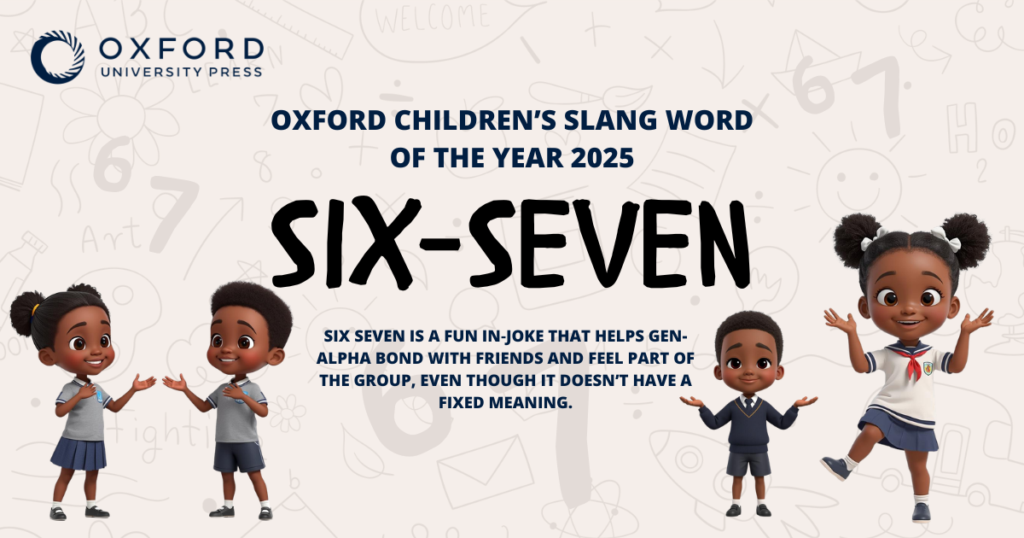
Six-seven is a term generated from an internet meme, which has no clear meaning. It highlights the flexibility of language as two numbers are combined to create a new word, but one which is hard to define.
Inasmuch as the phrase has no particular meaning, children love using it. They actually embrace its lack of a clear meaning, seeing it as part of its appeal. According to one of the teachers interviewed, children appreciate that ‘six-seven’ is a phrase that most adults do not understand.
The rise of six–seven highlights important truths about today’s learners. Below are brief reasons and case examples on how this slang presents opportunities for educators, and not as a playful trend that people see it as.
- An opportunity for teachers to foster teamwork among learners
According to the 2025 Oxford CWOTY research, children use slang to bond with peers and feel a sense of belonging. Teachers can leverage and harness on this observation to support group work, peer learning, and student engagement in their learners.
- An opportunity for parents and guardians to strengthen their bond with their children
Instead of dismissing such phrases, parents and guardians can treat them as windows into how their children interact socially and leverage them as entry points to engage deeply with their children. Recognising slang as a natural part of childhood will help adults to better connect with their children.
- An opportunity for content developers to develop new, updated, resonating content
The popularity of six–seven shows the need for content that reflects children’s real cultural experiences and integrates socially relevant, current examples. This is a call for creators to actively update learning materials, refresh storylines, and intentionally embed contemporary youth culture into educational content.
Article written by Bildad Makori